
8 Basic Chinese Strokes & Character Writing Rules (A Standard Guide for Beginners)
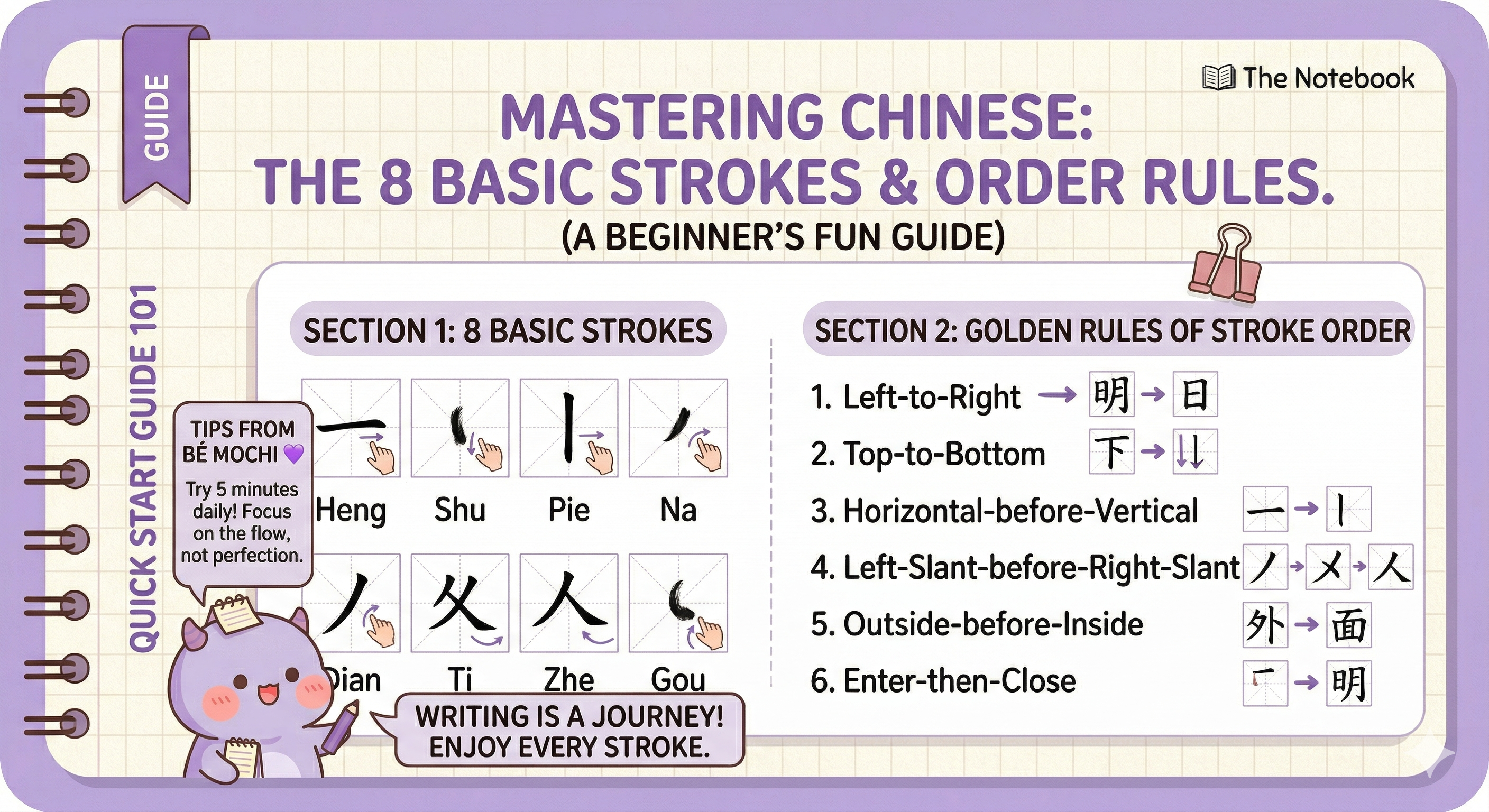
Looking at a Chinese character, does it look like a tangled "matrix" of lines?
Don't worry! Feeling overwhelmed is completely normal for anyone just starting out with an ideographic language. Actually, Chinese characters are not as scary as you think. Imagine that each character is just a Lego model, and your job is simply to master the shapes of the most basic "building blocks."
Today, little Mochi will open up this notebook with you to "decipher" how to write Chinese characters in the most visual and relaxing way possible.
1. The Eight Basic "Building Blocks" (8 Chinese Character Strokes) No matter how complex a Chinese character may be, it is formed from only 8 basic strokes. You just need to remember the shape and the direction of the pen:
Horizontal (一 - Héng): Draw a straight line from left to right. (Like the horizon).
Vertical (丨 - Shù): Draw a straight vertical line from top to bottom. (Like a tree growing straight up).
Throw/Left Slant (丿 - Piě): Curve from top to bottom, slanting to the left.
Press/Right Slant (乀 - Nà): Draw straight from top to bottom, slanting to the right.
Dot (丶 - Diǎn): A small dot, usually with a slight press of the pen.
Rise (㇀ - Tí): Draw from the bottom, flicking diagonally up to the right.
Turn/Fold (乛 - Zhé): A stroke with a sharp corner (a sudden change in direction).
Hook (亅 - Gōu): A straight (or curved) line drawn downward with a slight hook upward at the end.
A little tip from Mochi 💜: Don't try to memorize the names of the strokes right away. Just take a piece of scrap paper and practice drawing these lines very slowly so your hand gets used to the pressure and release of the pen.
2. "Puzzle" Rules (Stroke Order) Once we have the pieces, we need to know which piece to put down first and which comes later. Just follow these 6 golden rules, and your handwriting will look natural and balanced:
Left before Right: For example, with the character 明 (Míng - bright/clear): You write the 'Sun' radical (日) on the left first, then write the 'Moon' radical (月) on the right.
Top before Bottom: For example, with the character 二 (Èr - number 2): Write the short horizontal stroke on top first, then the long horizontal stroke on the bottom.
Horizontal before Vertical: For example, with the character 十 (Shí - number 10): Always draw the horizontal line first, then draw the vertical line cutting through it.
Left Slant before Right Slant: For example, with the character 八 (Bā - number 8): Write the left slant (丿) first, then the right slant (乀).
Outside before Inside: For example, with the character 月 (Yuè - moon): Draw the outer frame first, then write the two horizontal strokes inside.
Enter before Closing: For example, with the character 回 (Huí - to return): Draw the outer frame first (creating the 'house'), write the small square character inside ('entering the house'), and only then close the bottom horizontal stroke (closing the door).
Takeaway Writing Chinese characters is not like drawing a picture; it is a logical thinking process of assembly. When you write strokes in the correct order, your writing speed becomes much faster, and the characters will look boxy and beautiful.
The feeling of personally writing a complete Chinese character is incredibly "addictive"! Start practicing with the simplest characters.
About 1001 Word Team
We are a group of language and technology enthusiasts, committed to bringing a natural, smart, and effective language learning method through video and AI.